
Every few months someone on Reddit or LinkedIn asks the same tired question, and every few months the same panic spreads through junior dev circles. So let’s settle it properly: is WPF dead in 2026? Short answer no. Long answer it depends entirely on what job you’re asking it to do, and that’s the part most hot takes skip.
This isn’t a nostalgia piece. It’s a status check, built on what actually shipped in .NET 10, what Microsoft has said in writing, and what enterprise teams are still building on top of Windows Presentation Foundation right now.
Why “Is WPF Dead 2026” Keeps Trending
Here’s the thing — this question resurfaces every year almost like clockwork, and 2026 is no exception. Type “is WPF dead 2026” into any search bar and you’ll get a mix of Medium hot takes, Avalonia marketing posts, and Stack Overflow threads from 2021 still ranking on page one.
The pattern is predictable. A new cross-platform framework gets a funding round or a big release, someone writes a “why WPF is over” post, and the cycle restarts. It happened with UWP. It happened with early MAUI hype. It’s happening now with Avalonia and its commercial fork, Avalonia XPF.
But repetition isn’t evidence. Anyone who’s maintained a large WPF codebase for more than a year knows the framework’s actual trajectory doesn’t match the headlines. WPF isn’t getting flashy new features — that’s true, and worth being honest about. It’s also not disappearing, and those are two very different statements.
What Actually Shipped: WPF in .NET 10
This is where the “is WPF dead 2026” debate gets grounded in something concrete instead of vibes. .NET 10 released in November 2025 as a Long Term Support version, supported through November 2028, and it shipped real, documented changes to WPF — not just a maintenance stamp.
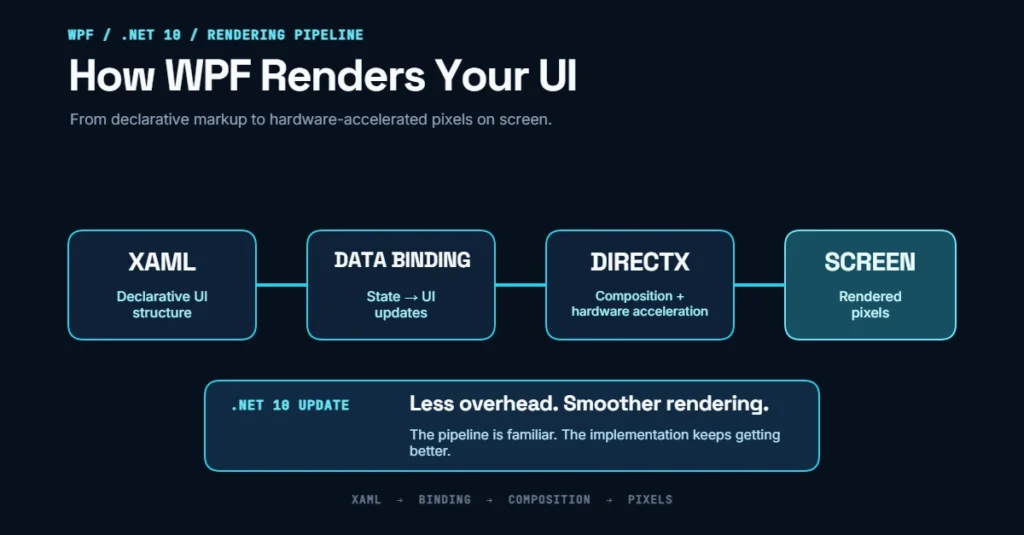
According to Microsoft’s official release notes, WPF in .NET 10 saw internal data structures replaced with standard .NET types such as ReadOnlyCollection, cutting allocations in UI automation and file dialogs and speeding up pixel format conversions. That’s not a cosmetic fix — that’s engineering effort going into rendering pipeline performance in a framework people keep calling abandoned.
There’s more. .NET 10 also brought Fluent-style updates across text-based controls like TextBox, DatePicker, and RichTextBox, along with clipboard code shared with WinForms through a common codebase. Preview builds surfaced a known bug around ThemeMode and BorderThickness in Fluent-styled controls — the kind of real, documented issue you only get from active development, not a framework on life support.
A Direct Quote From Microsoft
Teams debating whether to greenlight a new WPF project or migrate an existing one tend to want this in writing, not paraphrased. Here it is, straight from Microsoft’s own commitment on desktop frameworks:
“We are committed to continuing to improve Windows Forms, WPF, and WinUI for Windows desktop application development.”
That’s not marketing copy for a dying product. Companies don’t publish long-term support commitments — and back them with quarterly servicing releases — for something they’re quietly retiring.
What the Research Shows
Anyone answering “is WPF dead 2026” honestly needs to look past anecdotes and into actual usage data. Two data points matter here, and both come from verified sources.
First, C# itself remains firmly mainstream. The 2025 Stack Overflow Developer Survey found that C# is used by 27.8% of all respondents and 29.9% of professional developers, putting it well inside the top tier of languages developers actively work in. WPF rides on that base — a language decline would hurt WPF’s outlook far more than any UI trend, and that decline simply isn’t happening.
Second, look at where WPF still shows up on the ground. Applications for trading platforms, hospital monitoring dashboards, industrial HMI systems, and CAD tooling continue to lean on WPF specifically because of its mature data-binding engine and hardware-accelerated rendering through DirectX. Teams shipping real-time telemetry dashboards consistently find that WPF’s rendering pipeline handles sustained high-frequency updates better than most Electron or web-based alternatives at equivalent development cost.
Servicing Releases Tell Their Own Story
Microsoft’s monthly .NET servicing updates are a quiet but reliable signal. The March 2026 servicing release, for instance, shipped fixes explicitly versioned for WPF alongside runtime, ASP.NET Core, and Entity Framework updates. A framework getting rolled into active CVE and bug-fix cycles month after month isn’t a framework anyone at Microsoft has stopped touching.
Where the “Dead” Narrative Actually Comes From
Give the skeptics their due — there’s a real pattern behind the concern, even if the conclusion overshoots it.
No major feature investment. WPF hasn’t received a headline-grabbing capability in years. Compare that to WinUI 3 or MAUI, which get roadmap announcements and conference keynotes. WPF gets changelogs.
Microsoft’s stated cross-platform push. MAUI exists specifically to solve the problem WPF never tried to solve — running the same codebase on Windows, macOS, iOS, and Android. If your product needs that, WPF was never the right tool, and no amount of “is WPF dead 2026” debate changes that math.
Visual Studio designer stagnation. The XAML designer experience for WPF hasn’t evolved much, and teams working with WinUI or newer tooling notice the gap immediately when they switch projects.
Declining junior interest. Fewer bootcamps teach WPF. Fewer tutorials get made. That’s a talent-pipeline problem, not a technology-death problem, but it does create a self-reinforcing perception issue.
None of these points are wrong. They just don’t add up to “dead.” They add up to “mature and no longer the trendy choice” — which is a completely different category.
Implementing an MVVM Pattern That Still Holds Up in 2026
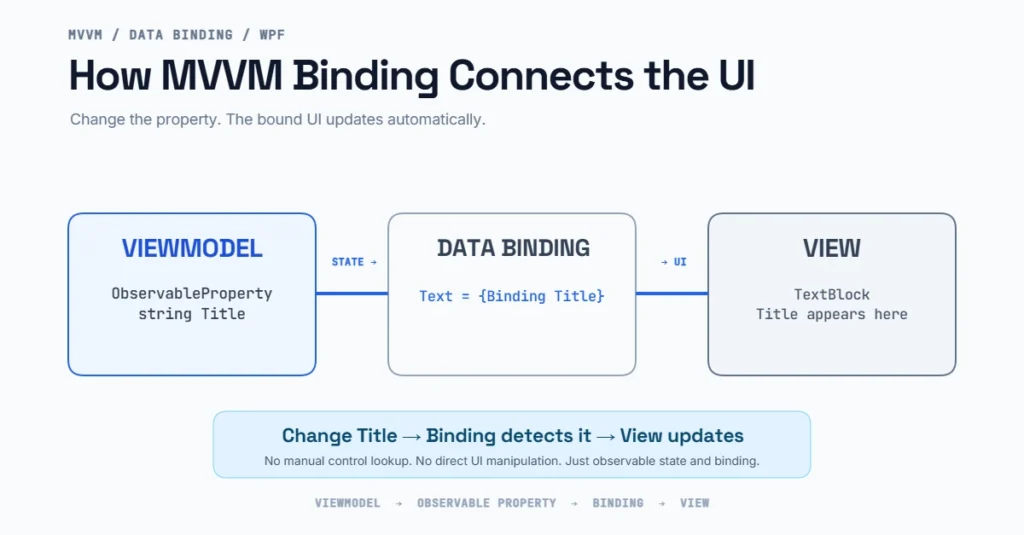
Since the whole “is WPF dead 2026” argument often hinges on whether the framework can still support modern architecture, here’s a real example. This is a trimmed MVVM setup using CommunityToolkit.Mvvm, which remains actively maintained and widely adopted in current WPF projects.
csharp
public partial class DashboardViewModel : ObservableObject
{
    [ObservableProperty]
    private double currentThroughput;

    [ObservableProperty]
    private bool isConnected;

    [RelayCommand]
    private async Task RefreshDataAsync()
    {
        IsConnected = false;
        var reading = await _telemetryService.GetLatestAsync();
        CurrentThroughput = reading.Value;
        IsConnected = true;
    }
}
xml
<TextBlock Text="{Binding CurrentThroughput, StringFormat='{}{0:N2} req/s'}"
           FontSize="24" Foreground="{DynamicResource AccentBrush}" />
<Button Content="Refresh" Command="{Binding RefreshDataCommand}" />
Source generators handle the boilerplate. Binding infrastructure hasn’t changed since .NET Framework days, but that’s exactly the point — this pattern was stable a decade ago and it’s stable today. Teams don’t need to relearn anything to stay productive.
Who Should Actually Care About This Debate
Junior developers deciding what to learn next shouldn’t pick WPF as their only skill, but shouldn’t avoid it either if a job posting calls for it — line-of-business enterprise roles still list it constantly.
Engineering managers maintaining legacy systems need to know migration to MAUI or Avalonia is expensive and rarely justified purely by “WPF feels old.” Rewrite only when a real cross-platform requirement exists.
Architects starting greenfield Windows-only, data-heavy desktop apps still have solid reasons to pick WPF over newer alternatives — mature tooling and third-party control libraries from vendors like Telerik and Syncfusion remain deep and battle-tested.
DevOps and platform teams should note WPF apps package cleanly with modern .NET SDK-style projects and self-contained deployment, so operational overhead isn’t the blocker some assume.
WPF vs the Alternatives, Honestly
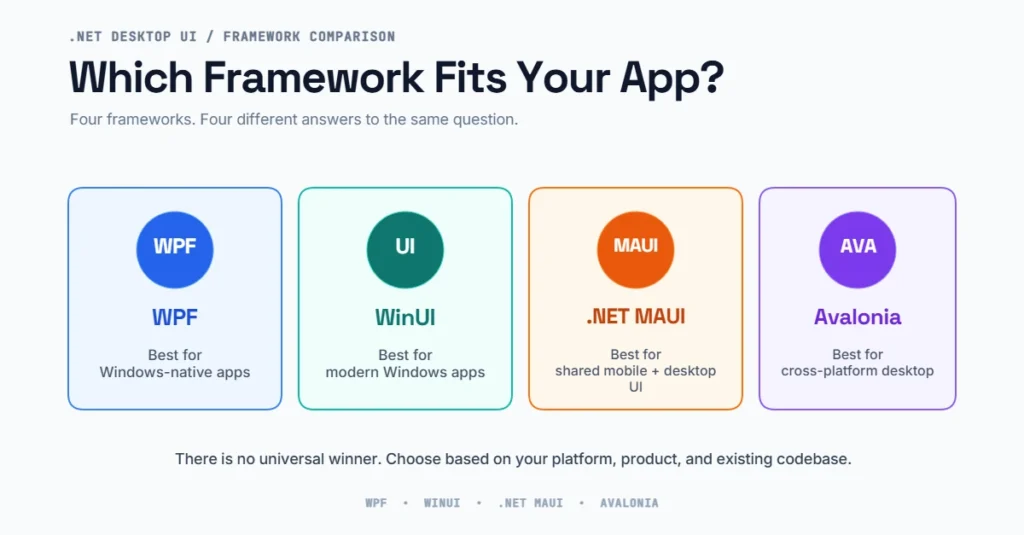
| Framework | Best fit | 2026 status |
|---|---|---|
| WPF | Windows-only, data-heavy enterprise apps | Stable, maintained, no major new features |
| WinUI 3 | Modern native Windows apps | Actively developed, Microsoft’s preferred forward path |
| MAUI | Cross-platform mobile + desktop | Active investment, mobile-first focus |
| Avalonia / XPF | Cross-platform desktop from XAML/WPF code | Growing fast, genuine WPF migration path |
Anyone who’s actually shipped on more than one of these knows the decision isn’t about which is “best” it’s about which constraint matters most for the project in front of you.
The Verdict
So, is WPF dead in 2026? No — and the servicing releases, the .NET 10 performance work, and the enterprise codebases running in production say so more clearly than any blog post could. It’s not the framework to reach for if you need true cross-platform reach, and it’s not getting flashy headline features. But “stable and unglamorous” isn’t the same as “dead,” and conflating the two has been the whole flaw in this debate since it started years ago. The real answer to is WPF dead in 2026 is that it’s exactly as alive as the millions of lines of enterprise code still running on it every single day.
Disclaimer: This article reflects verified .NET 10 release notes, Stack Overflow survey data, and Microsoft’s public statements as of mid-2026. Because the “is WPF dead 2026” debate resurfaces annually, readers evaluating a long-term architecture decision should check Microsoft’s official WPF release notes directly for the most current version-specific changes before committing.
FAQs
Is WPF still supported by Microsoft in 2026?
Yes. WPF ships as part of .NET 10, an LTS release supported through November 2028, and receives monthly servicing updates alongside the rest of the .NET stack.
Should I start a new project in WPF in 2026?
nly if your target is exclusively Windows desktop with complex, data-heavy UI needs. If cross-platform reach matters, MAUI or Avalonia are better starting points.
Is WPF being replaced by WinUI or MAUI?
Microsoft has shifted new feature investment toward WinUI 3 and MAUI, but WPF isn’t formally deprecated and continues receiving bug fixes and performance work.
Are WPF developer jobs still available?
Yes, particularly in finance, healthcare, manufacturing, and industrial software where legacy WPF systems require ongoing maintenance and modernization.
What’s the biggest risk of staying on WPF long-term?
The shrinking pool of developers actively learning it, not the technology itself. Teams should plan for knowledge transfer as senior WPF developers retire or move on.